What Is Retrieval-Augmented Generation (RAG)?
RAG lets an AI answer from your documents, not just its training. Here is what Retrieval-Augmented Generation is, how it works, and why our Local Advanced Intelligence (LAI) ships with private, on-premise RAG built in, on hardware you control.
RAG, in Plain Terms
RAG means Retrieval-Augmented Generation. Instead of answering purely from what a model learned during training, the system first retrieves the relevant facts from an external store, then augments the prompt with them, then generates an answer grounded in what it pulled. Plainly: the model stops guessing from memory and starts reading from your shelf before it speaks.
A model on its own has three hard limits. Its knowledge is frozen at the moment it was trained, so it does not know today's facts. Your private knowledge was never in it, not your docs, your code, your tickets, or your measurements. And the context window is finite, so you cannot paste a whole corpus into every prompt. RAG answers all three by fetching just the right few passages at answer time and handing them to the model as working context.
How RAG Works
The important word is meaning. Retrieval matches on what a passage is about, not on exact words, so it finds the right note even when you would never have guessed the term it was filed under.
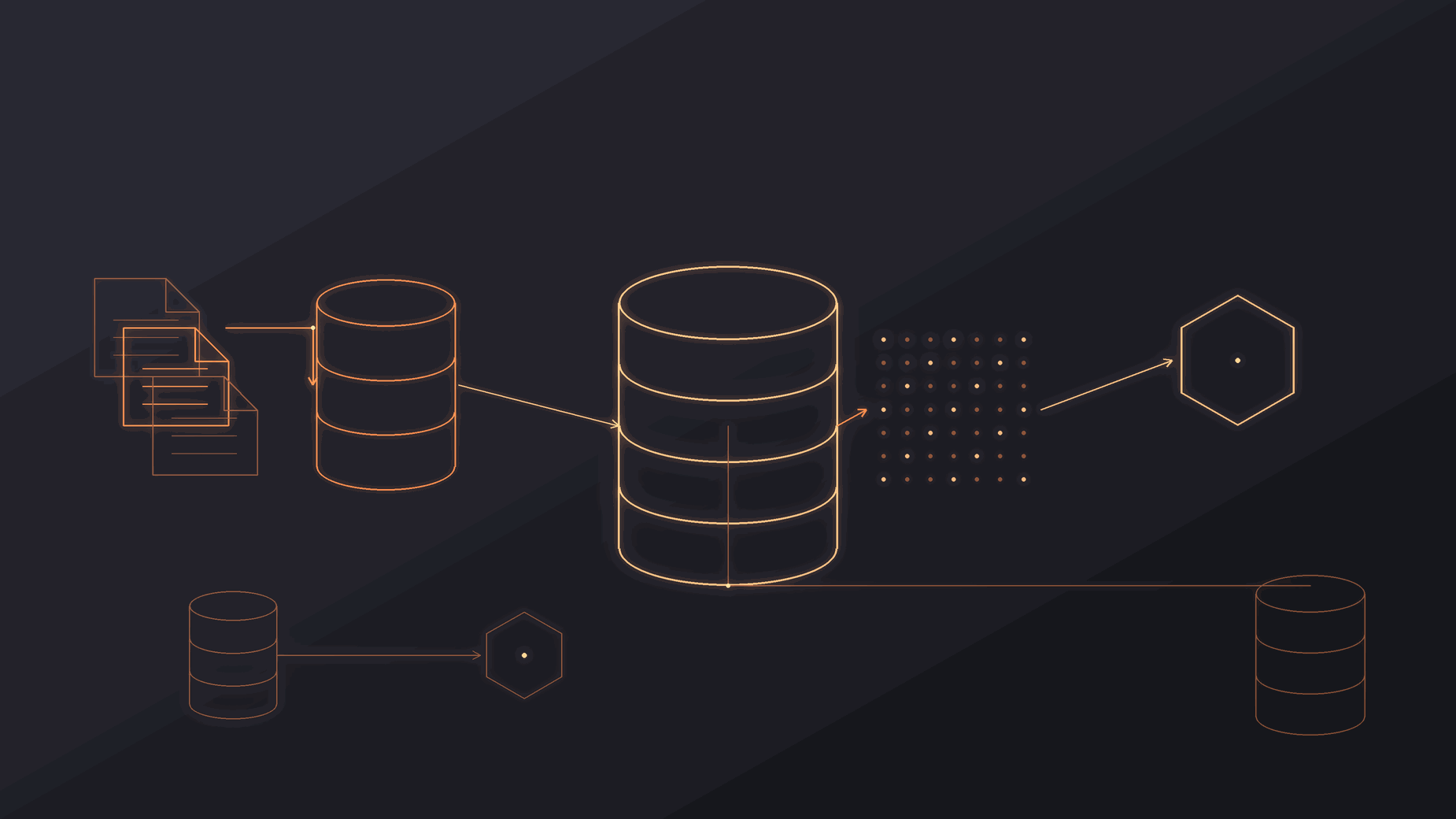
1 · Ingest & chunk
Your documents are split into passages sized for retrieval.
2 · Embed
Each passage becomes a vector, a numeric fingerprint of its meaning, stored in an index.
3 · Retrieve
The question is embedded the same way; the store returns the passages nearest in meaning, re-ranked for precision.
4 · Augment & generate
Those passages go into the prompt, and the model answers from them, citing which passage each claim came from.
What Changes When Retrieval Is There
Without a retrieval system, a person is the retrieval system: recall is a small index you keep in your head plus keyword search, and every note has to be written to be found. RAG removes that burden.
| Without RAG | With RAG |
|---|---|
| Notes must be named with the exact words you will search for | Finds by meaning; exact wording no longer matters |
| Your index has to stay small enough to hold in view | Scales to thousands or millions of documents |
| You hand-link related notes to reach neighbors | Surfaces related passages automatically |
| You search synonyms before concluding you do not know | One query reaches the whole corpus at once |
| You prune constantly so everything still fits | No index budget to defend |
Why Local Advanced Intelligence Comes With RAG
LAI, Local Advanced Intelligence, is advanced models running on hardware you control rather than behind someone else's API. RAG is not a bolt-on here, it is the point.
The reason to run local is your corpus
If you only wanted a general chatbot, a public API would do. You go local because your knowledge has to stay yours, and RAG is what turns that private corpus into answers. A local model without RAG is just an offline chatbot that does not know your work.
Data sovereignty, end to end
The documents, embeddings, vector store, retrieval, and generation all happen inside your boundary. No passage of your knowledge is shipped out to be indexed or queried. The locality that protects the model protects its memory too.
Freshness without retraining
You update the store, not the model. Add a document, re-index, and the assistant knows it immediately. No fine-tune, no retrain, no waiting for a new model.
Grounding, which is where truth comes from
A RAG answer can cite the passage it came from, so a claim is checkable against its source instead of taken on the model's confidence. The assistant is reading, not remembering, which is the biggest reduction in fabrication you can buy.
Open weights, local embeddings, no outside eyes
Local retrieval uses local embedding models, so building and searching the index never calls out. Your corpus is never seen by an outside service, at ingest or at query time.
It pairs with the rest of the stack
RAG is the knowledge layer of private AI hosting, and feeds the kind of correlate-and-answer work shown in the Network Intelligence module.
The Library and the Operating Rules
RAG does not replace every kind of memory, it sorts them into two homes. The big corpus, everything you might need to look up, belongs in RAG, retrieved on demand only when it is relevant. The small, always-true set, who you are, your standing preferences, and the behavioral rules that keep the assistant honest, stays in context on every turn, because you want those shaping every answer whether or not a query happens to surface them.
RAG for the library. A loaded rule set for how to behave. LAI gives you both.
The short version: RAG lets the model read your private knowledge at answer time instead of guessing from training, and LAI bundles it because local AI without local retrieval is a chatbot that does not know your work, and because grounding answers in retrieved, citable source is how a private assistant stays both truthful and yours.
Put your own knowledge behind a private model.
Tell us what your corpus looks like and where it has to stay. We will show you what Local Advanced Intelligence with RAG looks like running on your hardware.
Email info@mcgllc.com